What is on a call center assessment test?
A call center assessment usually checks your English (reading, listening and speaking), your typing, and how you handle a customer in a mock call. Some employers add a computer test or a personality questionnaire. The exact mix depends on the company and the account you are hired for.
TTEC, a BPO hiring in Manila, describes the common structure on its careers blog: the tests check "your ability to read, listen, type, and speak." Its five sections are a good map of what most applicants face after the first interview. For the full path from application to job offer, see the guide to becoming a call center agent.
Self-introductionSpeaking
"Tell me about yourself." TTEC advises keeping it under one minute.
Reading comprehensionReading
Read a short paragraph aloud, or answer questions about a text. Checks pace and pronunciation.
Listening and responseListening
Hear a sentence or short story, then repeat it or answer a question about it.
Mock call or role-playSpeaking
You play the agent. The recruiter or a computer program plays the customer.
Typing speed and accuracyTyping
Checks that you can take notes and use systems while talking to a customer.
Source: TTEC careers blog, How to pass a BPO language assessment (Manila), dated 24 April 2026. Order and content vary by employer.
Some employers run these on an online test platform. TTEC, for example, tells chat support applicants in Pampanga to prepare for "the Harver language proficiency and typing tests". Others give you the Pearson Versant, which covers the listening and speaking parts on its own.
What does the English assessment check?
The English part checks whether a customer can understand you and whether you understand them. TTEC lists clarity, confidence, comprehension and basic grammar as what recruiters look for, and says you do not need a perfect neutral accent to get hired.
Many BPOs use Pearson's Versant for this step. Pearson's Philippine page lists its English Speaking and Listening Test and its 4-Skills Essentials Test as used by call centers and BPO providers. The first is 17 minutes of short answers, repeating sentences, retelling stories and giving opinions. Our Versant test guide with free practice drills breaks down every part with Pearson's time limits.
Job posts rarely say which test they use. Of 50 live call center agent job posts we read on JobStreet on 25 September 2026 (the first results for "call center agent", plus the same search in five cities outside Metro Manila), 24 (48%) stated an English requirement, and none named Versant.
| Item | Value |
|---|---|
| State an explicit English requirement | 24 of 50 (48%) |
| Describe the hiring steps at all | 18 of 50 (36%) |
| Name an assessment step (other than Versant or typing) | 5 of 50 (10%) |
| State a typing speed | 1 of 50 (2%) |
| Name Versant | 0 of 50 (0%) |
Base: n = 50 live call center agent job posts on JobStreet, read 25 September 2026. Source: TrabahoFit review of JobStreet job posts
The five posts that named a step described it as an online assessment link, a "recruitment assessment", an "Initial Interview - Assessment - Final Interview - Job Offer" sequence, or an AI interview. Posts do not have to list every test, so expect an assessment even when the post is silent.
How many words per minute do you need for a call center typing test?
There is no industry-wide minimum. Each employer sets its own, and most do not publish it. In our sample, only 1 of 50 job posts stated a typing speed: 40 words per minute (WPM), for a permanent work-from-home agent role.
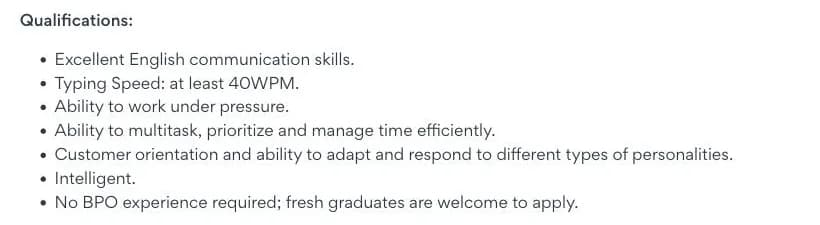
One employer publishes its figure on its own site. TTEC's chat support page for Pampanga (dated 6 August 2025) asks for "a typing speed of 35 WPM with accuracy". That is one employer and one non-voice role, so read it as an example. You will see other WPM ranges online; we could not trace any of them to an employer, so we leave them out.
Accuracy counts as much as speed. TTEC's Manila guide says "accuracy is more important than raw speed" and that a high speed with many errors lowers your score. If your employer uses Pearson's Versant 4 Skills Essential test, typing is built into it: in the Dictation part you hear a sentence once and have 25 seconds to type it word for word, and in Passage Reconstruction you read a passage for 30 seconds and get 90 seconds to rewrite it. Pearson's Versant English Placement Test also reports "typing speed and improvement".
How do you practice for the typing test for free?
Practice on text that looks like agent notes, with names, numbers and addresses, because that is harder than typing random words. Set a 1-minute timer on your phone, type one passage below into any notes app, then count the words you typed correctly. That count is your rough WPM. Fix accuracy first, then push speed.
Passage 1: account note
Customer called about a double charge on her June bill. Verified name, birth date and the last four digits of the account, 4821. Found two payments of 1,250 pesos on June 14. Raised a refund request for one payment, reference RF-30917. Advised the customer the refund may take up to seven business days. Customer agreed and ended the call.
Passage 2: delivery address update
Caller asked to change the delivery address for order 55-20488. New address: Unit 12B, Mabini Street, Barangay San Roque, Cebu City 6000. Confirmed the new address by reading it back twice. Order has not shipped yet, so the change was saved. Sent a confirmation text to the mobile number on file ending in 719.
Passage 3: technical support note
Customer reports no internet since 8:30 this morning. Router lights: power on, internet light blinking red. Asked the customer to restart the router and wait two minutes. Light still red after restart. Checked the area status page, no outage listed. Created a technician visit ticket, TKT-66102, for tomorrow between 9 AM and 12 NN.
TTEC also suggests taking free online typing tests before your assessment. If you type with two fingers, the slow part is learning to type without looking; practice that for 10 minutes a day and speed follows. TESDA's Contact Center Services NC II training regulations include keyboard techniques as part of the 144-hour course, if you want formal training.
What is the computer or web navigation test?
A computer-based test checks whether you can find information quickly on a screen and work with basic applications. The Philippine recruitment site iStaff.ph describes it as "a web navigation and research exam" given to CSRs handling data entry and to technical support applicants.
You can practice with a browser and a timer. Give yourself 2 minutes for each task:
- Find the opening hours of the nearest branch of any bank on its official website.
- Find the return or refund policy of an online shop and write down how many days you have to return an item.
- Open a long email, find the order number in it and copy it exactly into a notes app.
- Find the customer service hotline of a telco from its website only, without using a search engine result.
- In a spreadsheet, sort a list of 10 names alphabetically and add a column with today's date.
The skill being tested is finding the right detail fast while ignoring the rest. That is what you do on a call with a customer waiting.
What is a situational judgment or personality test?
A situational judgment test shows you a work situation and asks what you would do. A personality questionnaire asks how much you agree with statements about yourself. Both check how you handle customers, rules and pressure, and the best answers are usually the ones that are calm, honest and follow the process.
Three sample items, written by us:
- A customer shouts that this is the third time he has called about the same problem. Best answer: apologize, show you understand, and check the notes from his earlier calls before asking him to repeat anything. Weak answer: ask him to calm down first.
- A caller asks you to skip the verification questions because she is in a hurry. Best answer: explain that you need to verify to protect her account, and do it quickly. Skipping security is the weak answer.
- You do not know the answer to a customer's question. Best answer: tell the customer you will check, then use your resources or ask a supervisor. Guessing is the weak answer.
Answer personality questions honestly. Trying to guess a "right" profile makes it hard to answer consistently, and your answers should match the person who shows up for training.
What happens in the mock call?
In a mock call you act as the agent and someone plays a customer with a problem. TTEC says the recruiter or a computer program plays the customer, and the goal is to see how you handle a basic customer interaction. TTEC also notes that companies teach the product details in training, so you are not expected to know them.
Follow a simple five-step structure, using phrases like the ones TTEC suggests:
- Greet: "Thank you for calling [Company]. My name is [Name]. How can I help you today?"
- Verify: "Could you please provide your account number so I can look into this for you?"
- Empathize: "I understand how frustrating that must be."
- Resolve: repeat the problem back, explain what you will do, and do it.
- Close: "Is there anything else I can assist you with today? Thank you for calling."
For a full sample mock call and the questions that come before it, read our call center interview questions and sample answers.
Which parts of the assessment matter most for your role?
Voice roles lean on spoken English and the mock call. Chat and email roles lean on written English and typing. Technical support and data entry roles may add a computer test. The table shows what named sources say for each.
| Role | What to expect | Source |
|---|---|---|
| Voice customer service | Self-introduction, reading, listening and repeating, mock call, typing | TTEC, Manila |
| Chat and email (non-voice) | "Non-Voice Language Proficiency Test" for written English, typing test at 35 WPM | TTEC, Pampanga |
| Technical support, data entry CSR | Computer-based web navigation and research exam | iStaff.ph |
| Any role screened with Versant 4 Skills | Speaking, listening, reading, and typed Dictation and Passage Reconstruction | Pearson |
If your written English is stronger than your spoken English, read our guide to non-voice call center jobs, where typing and writing carry the most weight.
What if you fail the call center assessment?
You can usually try again later. TTEC says "many companies allow you to reapply after 30 to 90 days". Ask the recruiter for the exact waiting time and, if they will tell you, which part pulled your result down.
Use the waiting time on the weak part. Record yourself answering interview questions and reading aloud every day, run one typing passage a day and note your WPM, and rehearse the five-step mock call with a friend. Other companies may test differently, so applying elsewhere in the meantime is also practice.
No one can sell you a pass
Before you reapply, update your application so it shows what you have worked on. The call center resume guide covers what to list when you have no BPO experience yet.