What are the most common call center interview questions?
Five questions come up in almost every call center interview in the Philippines: “Tell me about yourself”, “Why do you want to work in a call center?”, “What are your strengths and weaknesses?”, “How would you handle an angry customer?” and “What is your expected salary?”. Prepare those five out loud and you have covered most of the first interview.
The rest of this page gives you 20 questions with a sample answer for each, written for someone with no call center experience. They are grouped the way an interviewer moves through them: about you, why this job, customer situations, availability, and salary. After that come the role-specific questions, the mock call and what to ask at the end.
No experience is normal for this job. We read 50 live call center agent job posts on JobStreet Philippines on 25 September 2026, in listed order from the “call center agent” search plus the same search in Cebu, Davao City, Iloilo, Pampanga and Bacolod. Of those 50 posts, 31 (62%) accept applicants with no experience, and 23 (46%) say so outright with lines like “fresh grads welcome”.
What happens during a call center interview in the Philippines?
A call center interview is usually one step in a longer hiring process: an initial interview, an assessment (often a spoken English test and sometimes a typing test or mock call), then a final interview with the account team. Many sites run several of these steps on the same day, so plan to stay a few hours.
Apply
Online or by walking in. Apply to several employers at once rather than waiting on one.
Initial interviewthis page
Short, usually in English. The recruiter checks how you speak more than what you know. The “about you” and “why this job” questions below come here.
AssessmentVersant, typing, mock call
Commonly a spoken English test plus a short exam. Some sites add a typing test or a mock call where you play the agent.
Final interviewthis page
With the account or operations team. Expect the situational questions, the salary question and the role-specific ones.
Offer and training
Training is usually provided when you start. Read what you sign, especially anything about a bond.
Steps vary by company and account. Of 50 live JobStreet call center posts read on 25 September 2026, 18 (36%) described their hiring steps at all; patterns included a one-day onsite process, a same-day job offer and a fully virtual process.
TTEC, one of the large employers in Manila, says its language assessments “test your language proficiency, including your ability to read, listen, type, and speak” (TTEC careers blog). The most widely known of these tests is Pearson’s Versant English Speaking and Listening Test, which runs 17 minutes (Pearson official guide). You can practice for the Versant test and prepare for the typing and assessment test on their own pages. For the bigger picture of the job itself, start with the call center career guide.
Job posts say surprisingly little about these tests. This is what the 50 posts we read put in writing:
| Item | Value |
|---|---|
| Accept applicants with no experience | 62% |
| Lowest education accepted is high school / SHS | 62% |
| State an explicit English requirement | 48% |
| Describe the hiring steps at all | 36% |
| Name an assessment step (other than typing or Versant) | 10% |
| State a typing speed | 2% |
| Mention Versant | 0% |
Base: n = 50 job posts (31, 31, 24, 18, 5, 1 and 0 posts). Source: TrabahoFit review of 50 live JobStreet Philippines call center agent posts, read 25 September 2026
Read the last bars carefully. Zero posts mention Versant, but posts do not have to list every test they use after you apply. Prepare for a spoken English test anyway, because the assessment step exists at most sites even when the post is silent about it.
How do you answer “Tell me about yourself” with no experience?
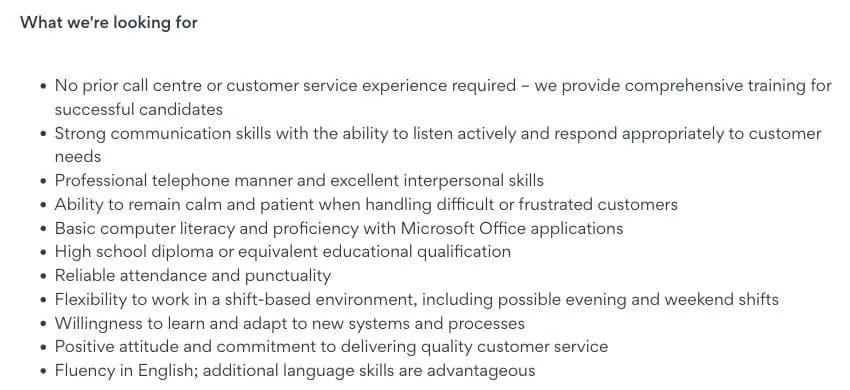
Give a 60 to 90 second answer in four parts: who you are, what you did most recently, one example of dealing with people or solving a problem, and why you want this job. Your example can come from school, a family business, church, volunteering or any part-time work. The recruiter is listening to your English and your confidence as much as your story.
Use this fill-in template, then say it out loud until it sounds like you talking:
“I’m [name] from [city]. I [finished senior high / college, or worked as …]. There I [one example of helping a customer, calming someone down or solving a problem]. I’m applying for this role because [one reason tied to customer service].”
Sample answer: fresh graduate
“Good morning. I’m Angela Reyes from Caloocan. I finished senior high school last year under the ABM strand. While studying, I helped at my tita’s sari-sari store after class, so I’m used to talking with customers, giving the right change fast and staying polite even when someone is in a hurry. I was also our class secretary, so I’m careful with notes and follow-ups. I’m applying for customer service because I like helping people fix a problem, and I want a stable job where I can keep learning.”
Sample answer: career shifter
“Good afternoon. I’m Mark Villanueva. For the past two years I worked as service crew at a fast-food branch in Pasig. I took orders, handled complaints at the counter and helped train new crew. The part I liked most was turning an upset customer into a happy one, especially during rush hour. I want to move into a call center because I already enjoy the customer side of the work, and I’m ready for a role with proper training and room to grow.”
Avoid saying: your full life story, your age and family details one by one, or “I have no experience” as your opening line.
What other “about you” questions do they ask, and how do you answer?
After “tell me about yourself”, expect four more questions about you: your strengths, your weakness, what you did since school or why you left your last job, and your proudest achievement. Keep each answer to four to six sentences with one concrete example. Short one-line answers read as nervous, and long memorized ones read as scripted.
1. What are your strengths?
“I’m patient and I listen well. At our family’s carinderia, regular customers would sometimes complain that their order was wrong or late. I learned to let them finish talking first, say sorry, and fix it quickly. Most of them kept coming back. I think that patience will help me on calls where the customer is already frustrated.”
Avoid saying: a list of five adjectives with no example.
2. What is your weakness?
“Sometimes I speak too fast when I’m nervous. I noticed it during school reports, so now I practice by recording myself on my phone and listening back. I also take one breath before I answer a question. It’s getting better, and I know training will help me even more.”
Avoid saying: “I’m a perfectionist” or “I have no weakness”. Recruiters hear both every day.
3. What have you been doing since you graduated? (or: Why did you leave your last job?)
“After graduation I helped my parents with our small business and took care of my younger siblings while my mom was working. Now that my siblings are older, I’m ready to work full time. I chose to apply at a call center because it offers training and a clear path to grow.”
Avoid saying: anything negative about a past boss or company, even if it is true.
4. What is your greatest achievement?
“In Grade 12, our group’s research project was about to fail because two members stopped replying. I divided their parts among the rest of us, set a daily check-in on Messenger and wrote the final draft myself. We finished on time and got one of the highest grades in our section. It taught me to stay calm and organize people when things go wrong.”
Avoid saying: an achievement with no problem in it. The problem is what makes it a good story.
How do you answer “Why do you want to work in a call center?”
Say that you enjoy helping people, that you communicate well in English, and that you want a job with training and a path to grow. Mentioning stable income is fine, but it cannot be your only reason. Then be ready for three follow-ups: what you know about the job, why this company, and how long you plan to stay.
5. Why do you want to work in a call center?
“I like talking to people and helping them solve problems, and I’m comfortable speaking English. A call center gives me training, a stable schedule and a chance to improve every day because every call is different. I also like that good performance is measured, so I can see myself getting better.”
Avoid saying: “Because the pay is high” or “Because it’s easy to get hired”.
6. What do you know about working in a call center?
“Agents handle customer concerns for a client, usually a company abroad, by phone, chat or email. Each client is called an account. You follow the account’s process, meet targets like call time and quality scores, and often work night shift because the customers are in another time zone. It’s fast-paced, but training is provided at the start.”
Avoid saying: “I don’t know much yet.” Read up on the types of BPO accounts before the interview.
7. Why do you want to work for our company?
“I read that your site here hires fresh graduates and gives paid training, which is what I need to start well. I also saw that you have healthcare accounts, and I like the idea of helping people with something as important as their health. A friend who works here said the team leaders are supportive, and that matters to me.”
Avoid saying: a generic answer that fits any company. Name one fact from their job post or website. Our list of BPO companies in the Philippines is a starting point.
8. How long do you plan to stay with us?
“I’m looking for a long-term job. I want to finish training, get good on my account and then work toward a role like quality analyst or team leader. I’d like to grow here and not keep starting over somewhere else.”
Avoid saying: that you plan to go abroad or back to school soon. Training costs the company money, so they want people who will stay.
How do you handle an angry customer and other situational questions?
Answer situational questions in three moves: stay calm and let the customer finish, show you understand with a short apology, then say what you would do to fix it or who you would bring in. If you have a similar story from your own life, tell it using the STAR method: the situation, the task you had, the action you took, and the result. These six come up most often.
9. How would you handle an angry customer?
“I would let the customer say everything first without cutting them off. Then I’d apologize for the trouble and repeat their concern so they know I understood. After that, I’d explain what I can do right now and give a clear next step. I’d keep my voice calm the whole time, because shouting back only makes it worse.”
10. What if a customer asks something you don’t know?
“I wouldn’t guess, because a wrong answer creates a second problem. I’d tell the customer, ‘Let me check that for you,’ ask permission to put them on a short hold, and look it up in our knowledge base or ask my team leader. Then I’d come back with the right answer.”
11. What if the customer asks for your supervisor?
“First I’d try once more to solve it, because many customers ask for a supervisor when they feel no one is listening. I’d say, ‘I understand, and I want to fix this for you. May I try one more thing?’ If they still want a supervisor, I’d follow the account’s process for escalation and explain the issue to the supervisor so the customer doesn’t have to repeat it.”
12. What if the same customer calls again about the same problem?
“I’d start by apologizing that they had to call again. I’d read the notes from the last call so I don’t ask the same questions, then check what was missed. Before ending the call, I’d confirm the fix with them and write clear notes so the next agent knows exactly what happened.”
13. What if a customer curses at you?
“I wouldn’t take it personally, because the customer is upset about the problem and I’m the person who can fix it. I’d stay calm and say something like, ‘I want to help you, and I’ll need us to keep this respectful so I can do that.’ If the cursing continues, I’d follow the account’s policy on abusive callers.”
14. What if you need to put a customer on a long hold?
“I’d ask permission first and tell them how long it might take. If it runs longer, I’d come back to the line every couple of minutes to update them so they don’t feel forgotten. When I return, I’d thank them for waiting.”
Avoid saying: “I would just transfer the call” or “I would hang up”. Both tell the recruiter you would pass the problem to someone else.
What do they ask about night shift, weekends and your start date?
Recruiters ask availability questions to make sure you will show up for the schedule the account runs. Answer yes only if it is true, and show you have a plan. Among the 50 posts we read, 17 (34%) mention a shifting or rotating schedule, 8 (16%) mention night or graveyard shift and only 3 (6%) mention a day shift; the other 22 (44%) say nothing about shift.
15. Are you willing to work night shift?
“Yes. I know most accounts serve customers in other time zones. I’ve already talked to my family about it, and I’m planning my sleep so I can rest during the day. I did night reviews before exams in school, so I know I need a routine to stay alert.”
16. Can you work on weekends and holidays?
“Yes. I understand the account follows the client’s holidays, which can differ from Philippine holidays. I just ask to know my schedule ahead of time so I can plan with my family.”
17. How will you get to work, especially at night?
“I live about 40 minutes away by jeep and MRT. For late shifts I checked that there are Grab and jeepney routes running at that hour, and I have a backup route if one is delayed.”
18. When can you start?
“I can start right away. My pre-employment documents are ready or already in process.”
19. Do you have any other applications?
“Yes, I applied to a couple of other companies, but this is one of my top choices because of the training and the account. If I get an offer here, I’m ready to decide quickly.”
Avoid saying: “No, only here.” It is fine, and normal, to apply to several employers at once.
Avoid saying: “Maybe” or “I’ll see” to any of these. If a shift truly does not work for you, say so and ask whether a work-from-home call center role or a different account might fit.
What is your expected salary, and how do you answer it?
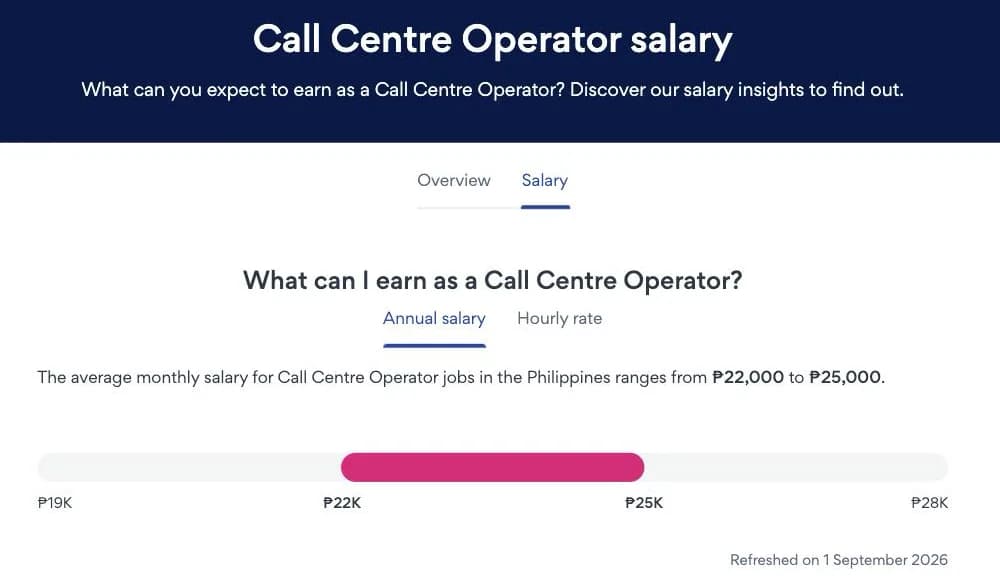
Give a monthly range that matches what entry-level posts advertise, and say you are open to the full package. In the 50 posts we read, 36 (72%) stated a salary, all monthly, and their median range ran from ₱20,000 to ₱25,000. Give a range close to that instead of a single number.
| Item | Value |
|---|---|
| Lowest posted minimum | ₱15,000 |
| Median posted minimum | ₱20,000 |
| Median midpoint of posted ranges | ₱22,500 |
| Median posted maximum | ₱25,000 |
| Highest posted maximum | ₱50,000 |
Base: n = 36 posts that stated monthly pay, out of 50 read. Source: TrabahoFit review of 50 live JobStreet Philippines call center agent posts, read 25 September 2026
Two third-party figures sit close to that. JobStreet puts the average monthly salary for call centre operator jobs at ₱22,000 to ₱25,000 (page refreshed 1 September 2026, no sample size shown; JobStreet). Indeed shows an average base salary of ₱21,097 a month for call center representatives, from 15.4k reported salaries, updated 20 September 2026 (Indeed). Several posts we read say their figure is a total package with allowances and incentives on top of basic pay, which fits posted ranges running a little above base-pay averages. The highest ranges came from one BPO site in Alabang and a recruiter post asking for 3 to 5 years of experience.
20. What is your expected salary?
“Based on the entry-level posts I’ve seen, I’m expecting around ₱20,000 to ₱25,000 a month. Since this would be my first call center job, I’m open to discussing it, and I’d like to know how the package works, including allowances, night differential and incentives.”
Avoid saying: “Any amount is fine” (it sounds desperate) or a figure far above the posted range with no experience to back it. See the full breakdown on the call center salary page.
What do they ask for tech support, non-voice, sales and VA roles?
Role-specific interviews add one or two questions that test the skill the account needs: explaining a fix for tech support, writing for chat and email, handling “no” for sales, and organizing for virtual assistant work. The table shows the extra question to expect for each of the five jobs you can pick in our quiz, and what to show in your answer.
| Role | Extra question to expect | What they check | What to show |
|---|---|---|---|
| Customer Service Representative | “Tell me about a time you helped someone who was upset.” | Clear English, patience, following a process | Slow, friendly delivery and a clear next step |
| Technical Support Representative | “How would you guide someone to restart their router?” | Explaining steps you cannot see, without jargon | Short numbered steps, checking after each one |
| Chat and Email Support Agent | “Write a reply to this customer complaint.” | Grammar, spelling, typing speed | A short, polite reply with zero typos |
| Outbound Sales Agent | “The customer says they’re not interested. What do you say?” | Handling rejection, keeping the talk going | One question that reopens the conversation |
| Virtual Assistant | “How do you keep track of many tasks for one client?” | Organization, Google Workspace | A named tool (Sheets, Calendar) and a routine |
Sample answer: tech support
“First I’d ask if the router lights are on. Then I’d say, ‘Please unplug the router, count to 30, and plug it back in. Tell me when the lights stop blinking.’ I’d wait, then ask them to open a website to check. If it still doesn’t work, I’d move to the next step in our troubleshooting guide.”
Sample answer: outbound sales
“I’d thank them and ask one question: ‘May I ask what you’re using right now?’ If they answer, I can connect our offer to what they already have. If they still say no, I’d end politely, because pushing too hard can lose the customer for good.”
Chat and email roles are not always separate jobs. In our 50 posts, none was purely non-voice, and 11 (22%) were blended roles mixing phone with chat or email. Read more about non-voice call center jobs if your written English is stronger than your spoken English.
What is the mock call and how do you pass it?
In a mock call you play the agent and the recruiter plays the customer. TTEC describes it this way: “You will act as the agent answering customer calls, and the recruiter or computer program will act as the customer” (TTEC). You pass by following a clear call structure, staying polite and solving the problem, even with an imperfect accent.
On accent, TTEC is direct: “No, you do not need a perfect neutral accent to get hired.” Speaking clearly and at a steady pace matters more. Use these five steps on every mock call:
- Greet and brand: say the company name and your name.
- Verify: confirm who you are talking to, such as name and order or account number.
- Empathize: repeat the concern and apologize for the trouble.
- Resolve: explain what you will do and do it, or give a clear next step.
- Close: confirm the fix, ask if there is anything else, thank the customer.
Sample mock call: late delivery
| Step | Who | What is said |
|---|---|---|
| Greet | Agent | “Thank you for calling ShopEasy, this is Angela. How may I help you today?” |
| Customer | “My order was supposed to arrive three days ago. This is ridiculous.” | |
| Verify | Agent | “I’m sorry to hear that. So I can check, may I have your full name and order number, please?” |
| Customer | “John Miller, order 48213.” | |
| Empathize | Agent | “Thank you, Mr. Miller. I understand you were expecting it on Monday, and I’m sorry for the wait. Let me check where it is.” |
| Resolve | Agent | “I see the package was delayed at the warehouse. It shipped this morning and should arrive by Friday. I’ve also added a note so you get a tracking update by email today.” |
| Customer | “Okay. Friday is fine.” | |
| Close | Agent | “Great. To confirm, your order arrives by Friday and you’ll get tracking today. Is there anything else I can help you with? Thank you for calling ShopEasy, and have a nice day.” |
The three mistakes that fail a mock call
- Skipping verification and jumping straight to the solution.
- Arguing with the customer or blaming another department.
- Ending without a clear next step, so the customer does not know what happens now.
What should you ask the interviewer at the end?
Ask one or two practical questions about the account, schedule, training and next steps. It shows you are serious and helps you decide if the job fits. Skip salary here if they already covered it.
- “What account would I be handling, and is it voice, non-voice or blended?”
- “What shift does the account run, and does it rotate?”
- “How long is training, and is it paid?”
- “When can I expect to hear about the next step?”
What should you bring to a call center interview?
Bring a printed copy of your resume, at least one valid government ID, a pen, and your phone charged in case they send an assessment link. Dress neatly in business casual. If this is your first job, you may be able to get your government pre-employment documents for free.
Under Republic Act 11261, the First Time Jobseekers Assistance Act, first-time jobseekers do not pay fees for covered documents that include the NBI clearance, police clearance, barangay clearance and birth certificate. The law says the benefit “shall only be availed of once” (RA 11261 on Lawphil). If your resume still needs work, follow our call center resume template for applicants with no experience.
How do you spot a fake call center job offer?
A legitimate employer does not ask you to pay to apply and does not interview you only by chat on Messenger or Telegram. If someone asks for a fee, your bank details, or a “reservation” payment before hiring, stop. Check the job on the company’s own careers page.
Four red flags
- A request for money or bank details. Concentrix states: “We will NEVER ask you for money, pre-payment or bank account information of any kind upon application of employment” (Concentrix).
- An “interview” done only by text chat. Concentrix: “We will NEVER conduct an interview via text chat in Facebook Messenger, Telegram, or Google Hangouts.”
- A job board or agent charging a registration fee. The DOLE job portal says “there is no registration fee or commission fee given to registrants of the PhilJobNet” (PhilJobNet).
- A guaranteed job or salary before you have done any interview or assessment.
What should you do if you fail the call center interview?
Write down every question you were asked, fix the answers that went badly, and apply to other employers right away. You can often reapply to the same company later: TTEC says “many companies allow you to reapply after 30 to 90 days” (TTEC). Use the wait to practice.
Before you reapply, check these three things:
- Length of answers: were they one line? Aim for four to six sentences with one example.
- Pace: record yourself answering “tell me about yourself” and listen for words you rush.
- The step that stopped you: if it was the English test or typing, practice that step on its own before your next attempt.