What is the Versant test?
The Versant test is an automated English test made by Pearson. You take it online (the Speaking and Listening version works on a phone app or in a web browser), a computer scores your answers, and results are usually ready within minutes. Pearson lists its Versant tests as used by corporations, call centers and BPO providers, which is why so many Filipino applicants meet it during hiring.
Pearson says it delivers over 3 million Versant tests each year. The Speaking and Listening version scores four things: Overall Ability, Speaking, Listening and Manner of Speaking. Pearson defines Manner of Speaking as speaking in a way proficient English speakers easily understand, at a normal pace, without too much hesitation. It is one step in a longer process, which the guide to becoming a call center agent walks through from application to job offer.
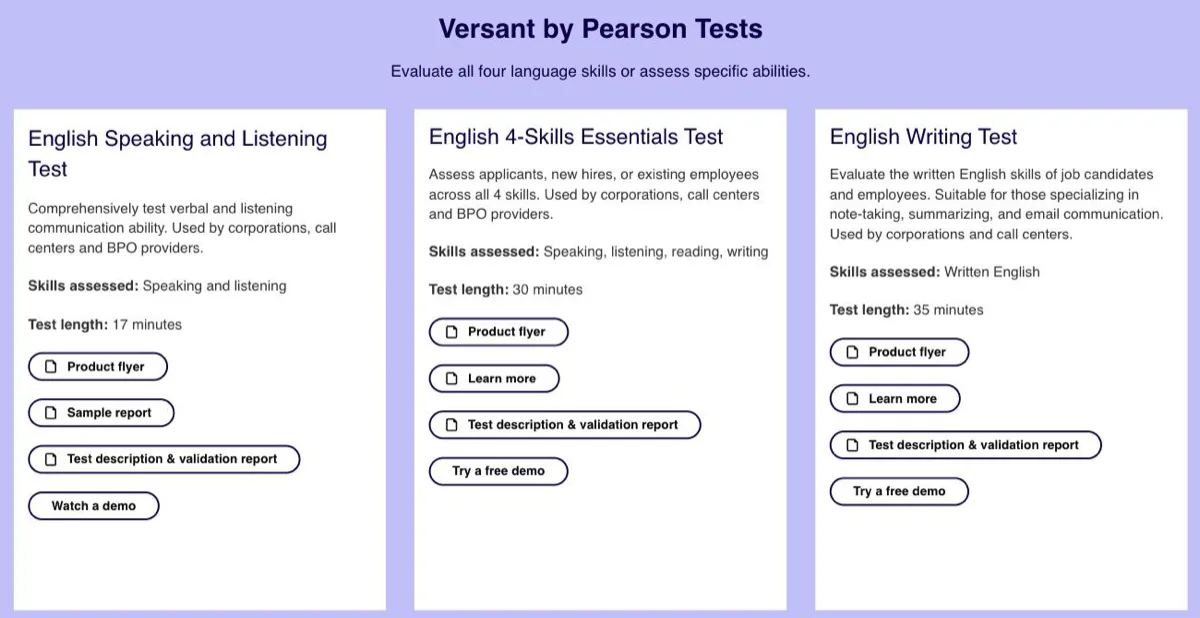
What is on the Versant Speaking and Listening test?
Pearson's current English Speaking and Listening Test has six parts, A to F, and takes 17 minutes in total. Every question is timed. If you do not start speaking within 6 seconds (Parts A and B) or 8 seconds (Parts C and D), the test moves on to the next question, and you cannot go back or re-record an answer.
The six parts below come from Pearson's Official Guide for Test-Takers (2024). The item counts add up to 40 questions; that total is our sum of Pearson's numbers.
Part A: Give a short answer to the question8 items · 15 s each
You hear a short question once and answer with a single word or a short phrase. Tests listening.
Part B: Repeat the sentence16 items · 15 s each
You hear a sentence and repeat it. Tests listening, speaking and manner of speaking.
Part C: Answer a question about a conversation6 items · start within 8 s
You hear a short conversation between two people, then a question about it. Tests listening.
Part D: Answer questions about a passage6 items · start within 8 s
You hear a short story, then three questions about it. Tests listening.
Part E: Retell a passage2 items · 30 s each
You hear a story and retell it in your own words. Tests speaking, listening and manner of speaking.
Part F: Give your opinion2 items · 40 s each
You hear a question and give your view with a reason. Tests speaking and manner of speaking.
Source: Pearson, Versant by Pearson English Speaking and Listening Test, Official Guide for Test-Takers (2024). Total test length 17 minutes; 40 items is our sum of the item counts.
Part B carries the most items, 16 of the 40. It is also the part that rewards practice most directly, because the task never changes: listen, hold the sentence in your head, say it back.
What is on the Versant 4 Skills Essential test?
The Versant 4 Skills Essential test adds reading and writing to speaking and listening, and takes about 30 minutes. Pearson's Philippine page calls it the "English 4-Skills Essentials Test" and also marks it as used by call centers and BPO providers. You take it on a computer, and three of its six parts ask you to type, so your typing speed matters here too.
| Part | Task and skill | Items | Time limit |
|---|---|---|---|
| A | Repeat: say each sentence exactly as you heard it (speaking) | 16 | 15 s per item |
| B | Sentence Builds: hear three short phrases in random order and say them as one sentence (speaking) | 8 | 15 s per item |
| C | Conversations: answer a question about a short conversation (listening) | 12 | Timed per item |
| D | Sentence Completion: type the one word that fits the gap (reading) | 18 | 25 s per item |
| E | Dictation: type the sentence you hear, word for word (listening and writing) | 14 | 25 s to type |
| F | Passage Reconstruction: read a passage, then rewrite it in your own words after it disappears (reading and writing) | 2 | 30 s to read, 90 s to write |
Source: Pearson, Versant 4 Skills Essential Test, Official Guide (April 2021). Total length is approximately 30 minutes. If your employer gives you this version, the Dictation and Passage Reconstruction parts overlap with the typing section of the call center assessment and typing test, so practice for both at once.
Which Versant test will a call center give you?
You will not know until the recruiter tells you, so ask. Pearson lists both the 17-minute Speaking and Listening Test and the 30-minute 4 Skills Essential test as used by call centers and BPOs. Job posts rarely say which one, or whether Versant is used at all.
Of 50 live call center agent job posts we read on JobStreet on 25 September 2026 (the first results for "call center agent", plus the same search in Cebu, Davao City, Iloilo, Pampanga and Bacolod), none named Versant. About half asked for English skills without naming any test.
| Item | Value |
|---|---|
| State an explicit English requirement | 24 of 50 (48%) |
| Name an assessment step other than Versant | 5 of 50 (10%) |
| State a typing speed | 1 of 50 (2%) |
| Name Versant | 0 of 50 (0%) |
Base: n = 50 live call center agent job posts on JobStreet, read 25 September 2026. Source: TrabahoFit review of JobStreet job posts
A separate JobStreet keyword search for "versant" on the same day returned 9 listings. We opened 6. Five of them advertised that they do not require it, with lines such as "NO VERSANT, NO SVAR, NO BERLITZ" and "No Mock Call & No Versant". One listed Versant as a hiring step. That post is outside our 50-post sample and is shown below.
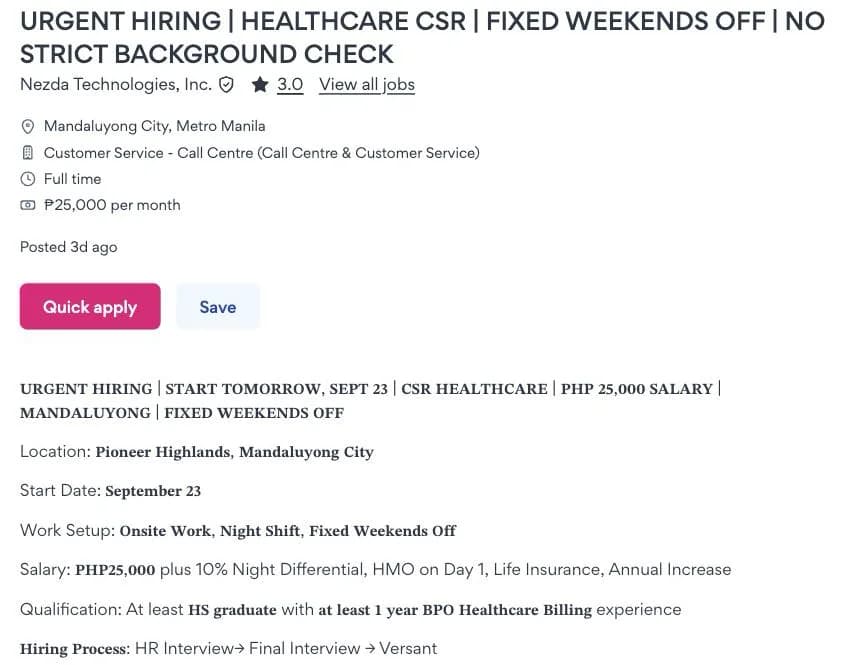
So posts mention Versant more often as a hurdle a recruiter promises to skip than as a stated requirement. That does not tell you how often it is used after you apply, because employers do not have to disclose it in a post. When you are invited to an assessment, ask these three questions:
- Is the English test Versant, or a different test?
- Is it the speaking and listening test only, or the version with reading and typing?
- Do I take it at home on my phone, or at your site?
How is the Versant test scored?
Pearson's current Speaking and Listening Test (2024 guide) reports your score on the Global Scale of English (GSE) and on the CEFR, the European scale that runs from A1 to C2. The GSE runs from 10 to 90. The 4 Skills Essential guide (2021) lists a third scale on its reports, the Versant scale. A computer scores every answer, which is why results come back within minutes.
The Versant scale runs from 20 to 80. You may see it on 4 Skills Essential reports, on older Versant English Test reports and on Pearson's Versant English Placement Test, a 50-minute test used by universities and language schools, reports on 20 to 80. Pearson's own sample score report (2022) for the Versant English Test shows both scales side by side and gives one example: "GSE 59/90 is equivalent to Versant 58/80". That is the only conversion point Pearson publishes in the documents we checked, so do not convert other scores yourself.
| Scale | Range | Where you see it |
|---|---|---|
| Global Scale of English (GSE) | 10 to 90 | Speaking and Listening and 4 Skills Essential reports |
| CEFR | A1 to C2 | Same reports, next to the GSE |
| Versant scale | 20 to 80 | 4 Skills Essential reports (2021 guide), older Versant English Test reports, the Placement Test |
What Versant score do you need for a call center job?
There is no single passing score. Pearson does not set one; each employer, and often each account, sets its own. TTEC, a BPO hiring in Manila, says on its careers blog: "Passing scores vary depending on the company and the specific account requirements."
You will find sites that name a range such as "55 to 62 for call center roles". Those numbers come from third-party practice sites, and we could not find them in any Pearson document. They are also written on the 20 to 80 Versant scale, which the 2024 Speaking and Listening guide does not use at all. Treat them as rumor. The only way to know the score your account wants is to ask the recruiter.
Nobody can sell you a pass
How do you practice for the Versant test for free?
Practice each part with the official time limit, out loud, and record yourself on your phone. The prompts below are written by us in the style of each part. They are not Pearson questions. Ask a friend to read them to you, or record yourself reading them and play them back after a pause.
Part A drill: short answers (15 seconds each)
- "What do you use to cut paper?" (Scissors.)
- "If a store opens at nine and closes at five, how many hours is it open?" (Eight.)
- "Which is bigger, a jeepney or a bicycle?" (A jeepney.)
Answer in one or two words. Long answers waste time and add nothing to the score.
Part B drill: repeat the sentence (15 seconds each)
- "Please hold while I check your account."
- "The new branch opens on the first Monday of next month."
- "She forgot her password and asked for a reset link."
Have someone read each sentence once, then say it back at a natural pace. Start with short sentences and add length. Listen to your recording for missing small words such as "the", "a" and "of".
Part C drill: a question about a conversation (start within 8 seconds)
Woman: "Did you send the report?" Man: "Not yet, the printer is broken." Question: "Why didn't the man send the report?" (Because the printer is broken.)
Start speaking right away. A short, correct answer beats a long pause.
Part D drill: questions about a passage (start within 8 seconds)
"Ana ordered a phone online. It arrived two days late, and the box was damaged. She called the store, and they sent a new one the next day." Questions: What did Ana order? What was wrong with the box? What did the store do?
Part E drill: retell a passage (30 seconds each)
"Mark missed his bus to work, so he walked to the next stop. On the way, he found a wallet on the sidewalk. He took it to the guard at his office, who found the owner's ID and called her." Retell it in your own words: who, what happened, how it ended. Keep talking until the time runs out, without long pauses.
Part F drill: give your opinion (40 seconds each)
- "Is it better to work from home or in an office? Why?"
- "Should students have part-time jobs while studying? Why or why not?"
Use a simple frame: your answer in one sentence, one reason, one example, then repeat your answer. Set a 40-second timer on your phone and practice until you finish close to the end without rushing.
Other free and paid options
Pearson's 4 Skills Essential guide recommends requesting a free unscored sample test from the Versant website, which lets you hear the format before the day. For a general English check, the EF SET is free online, with a full test of 90 minutes and a shorter one of 50 minutes, and gives results aligned with CEFR levels. It is a different test, so your EF SET result will not predict your Versant score. Pearson itself sells official Versant practice tests on its test-taker preparation page.
What mistakes should you avoid on test day?
The costliest mistakes are silence and panic. The test moves on if you do not start speaking within 6 or 8 seconds, and you cannot go back or re-record. Pearson's guide says an unfinished answer is saved and scored as it is, so a partial answer given on time beats a perfect answer you never start. The tips below come from the same 2024 guide.
- Take it somewhere quiet. Pearson warns that even loud fans and air conditioning can interfere with the recording.
- Use a headset with a microphone. Pearson lists "a headset with a microphone boom" and a good internet connection as requirements. Check it is properly connected before you start.
- Do not correct yourself. Pearson's tips say you should not correct yourself. If you slip, keep going.
- Speak at a normal speed and volume. Pearson's advice is not to rush, not to speak extra slowly, and not to shout or whisper.
The Philippine recruitment site iStaff.ph names sounds Filipino applicants often mix up: "p" and "f", "v" and "b", the "th" sound and the "s" sound. Use them as practice targets in the Part B drill. For example, record "The first file is very valuable" and "I think these three things are fine", then listen back. The same habits help in the spoken rounds, so work through the call center interview questions and sample answers out loud as well.
Can you retake the Versant test?
It depends on the employer. When a company gives you the Versant as part of hiring, that company decides when you can try again. TTEC says on its careers blog that "many companies allow you to reapply after 30 to 90 days." Ask the recruiter for the exact waiting time before you leave.
Use the waiting time well. Record one drill from each part every day, and listen back for the parts where you paused or lost the thread. If you apply to a different company in the meantime, it may use a different test, so prepare for the whole assessment day. If the employer gives you a score report, you can mention the score on your application; the call center resume guide shows where it fits.